Rail & Marine
HTM SoftNose Tram
Pedestrian Impact Evaluation with a Tram Front
Working closely with the Netherlands, Simpact carry out a pedestrian impact evaluation with a tram front end. And then help to develop a new 'softer' front end design that reduces impact loads/injury risk to pedestrians or cyclists.
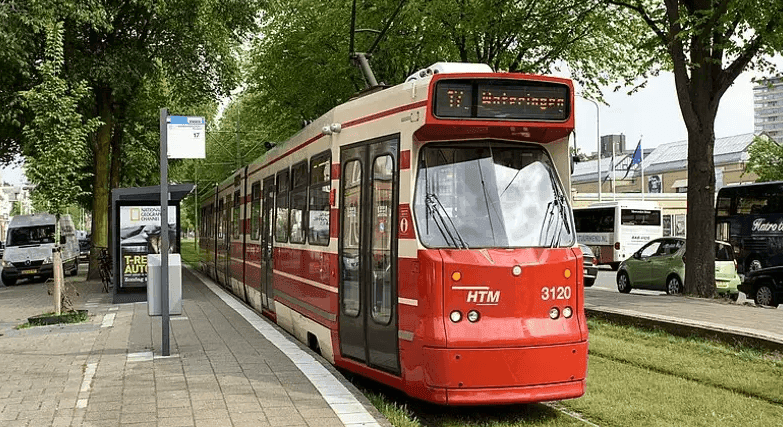
Tram Pedestrian Safety
No generally accepted impact safety standards are in place for trams. It is know from accident statistics that trams form a particular risk for vulnerable road users such as pedestrians and cyclists. In most cases these impacts result in serious head injuries.
In this study, a numerical model of an anthropomorphic testing device referred to as the EuroSID is used to derive body loads that can be related to injury risks. Although this dummy was developed to measure occupant loads in passenger vehicle side impact events, the assessment scale - the same scale used in the pole impact part of the EU-NCAP (European New Car Assessment Program) as in tram impacts, they form a perpendicular threat are highly relevant for head injury.
The developed FEA model of the tram front end was then used to drive the design of a 'softnose' version of the tram front end.
Target Setting
The study focussed on pedestrians and cyclists impacted by the tram front travelling at 8m/s (28.8 kmph).
No statistical detail on tram impact velocities was available so this only allowed for a qualitative interpretation of the injury risk implications of the add-on Softnose based on the FEA work. The 8 m/s impact velocity which coincided with the maximum speed at which tram under-run protection systems fully deploy. It also coincides with the pole impact velocity in EuroNCAP. This meant that the dummy load readings will be in a valid range for the assessment protocol.
Our targets were therefore:
- To create an accurate and reliable model of the existing tram front end that will provide relevant EuroSID impact loads.
- Provide a qualitative interpretation of the injury risk given the design modifications based on the FEA.
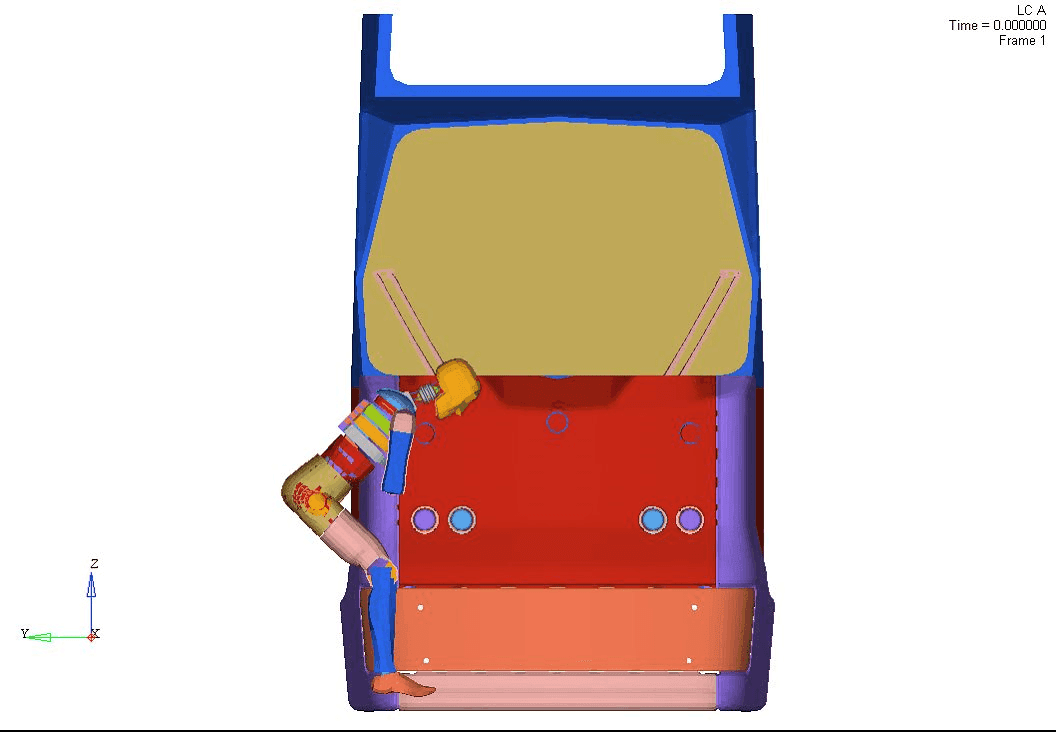
FEA Model
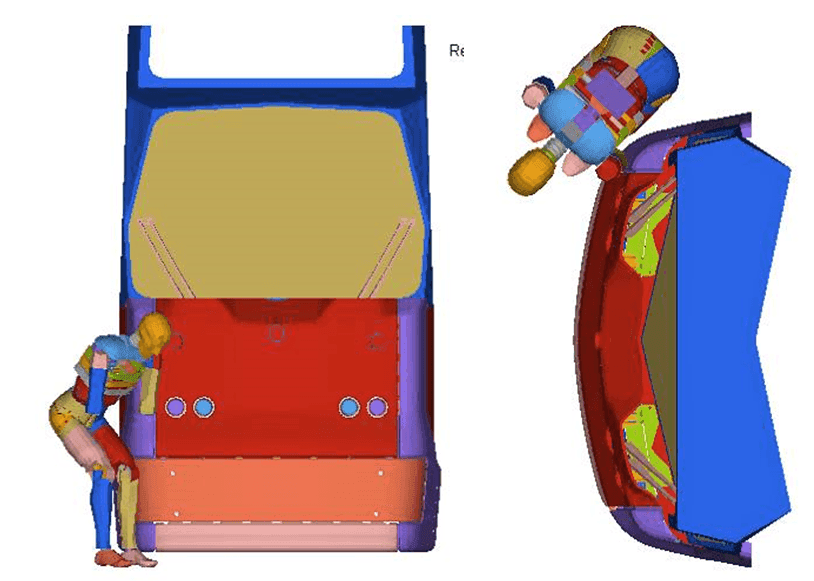
Seven load cases, A to G
The FEA model is built from CAD of the proposed design from our customers design team in the Netherlands. The new components are constrained to main front parts of the HTM original front. Non-linear material properties are determined for the ABS panels, steel bracketry and glass. A model of the wiper arms was incorporated and they are mounted to the original front using rigid links, which represents wiper mounting. The original HTM front end (apart windscreen, was modelled as rigid because of the strength of the underlying structure.
In total six perpendicular impact load cases were considered which represented six areas of possible impact. The impact positions were derived assuming worst case scenarios for the head impact on the Softnose. All load cases were set so that the EuroSID Dummy is positioned with its left-hand side towards the HTM Softnose. It can be assumed that the tram front is largely symmetrical. The Tram was given a prescribed constant velocity of 8 m/s (i.e.: 29km/h as in FMVSS 201 and EuroNCAP pole impact protocol) relative to the stationary dummy.
Analysis Results
Head acceleration, HIC and Pelvic force are drastically reduced
Acceleration response (head peak acceleration in g and HIC is plotted for each loadcase and tram front end. The values are filtered with SAE filter class 180.
Rib displacement values are extracted from the rib which showed the largest displacement. Peak force is also included Pubic symphysis which is a central load cell in the dummy where the left and right pubic bones meet.
For the impact conditions investigated, head acceleration, HIC and Pelvic force are drastically reduced from fatal and disabling levels to survivable with the addition of the developed softnose components.